


Nothing Happens Until It Does: KanAm’s Leading Cities Invest Collapse and the Terrifying Fat Tails of Open-Ended Real Estate Funds
Only days ago, the news hit the German financial market like a thunderclap: KanAm’s open-ended real estate fund Leading Cities Invest is being wound down. Burdened by an uncontrollable strain of capital outflows and a deteriorating real estate environment, the fund has thrown in the towel.
For years, open-ended real estate funds were sold as the bedrock of conservative portfolios - boring, steady, and safe. But as the KanAm collapse demonstrates, these vehicles are a textbook example of what Nassim Nicholas Taleb describes in his Statistical Consequences of Fat Tails. They embody a dangerous structural illusion: low risk most of the time, punctuated by sudden, catastrophic, power-law-driven collapses.
To put it bluntly: Nothing happens, until it does.
The Illusion of the Stable “Body”
When you look at the daily price changes at KanAm over its lifetime, the overwhelming majority of days are completely uneventful.
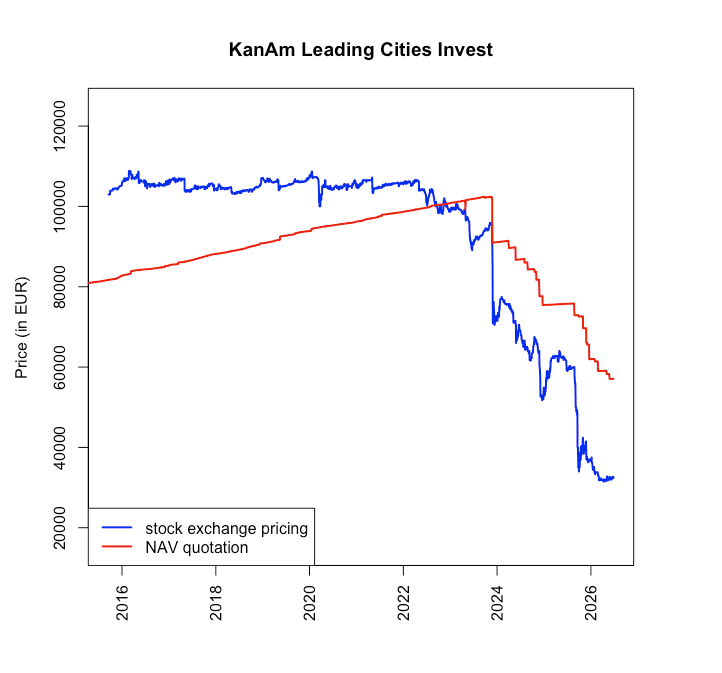
KanAm Leading Cities Invest - a Tale of Two Markets:
- The NAV Quotation: For years, it crawled upwards in a smooth, seemingly risk-free line.
- The Stock Exchange Pricing: It traded tightly around the NAV, reflecting a confident, highly liquid secondary market.
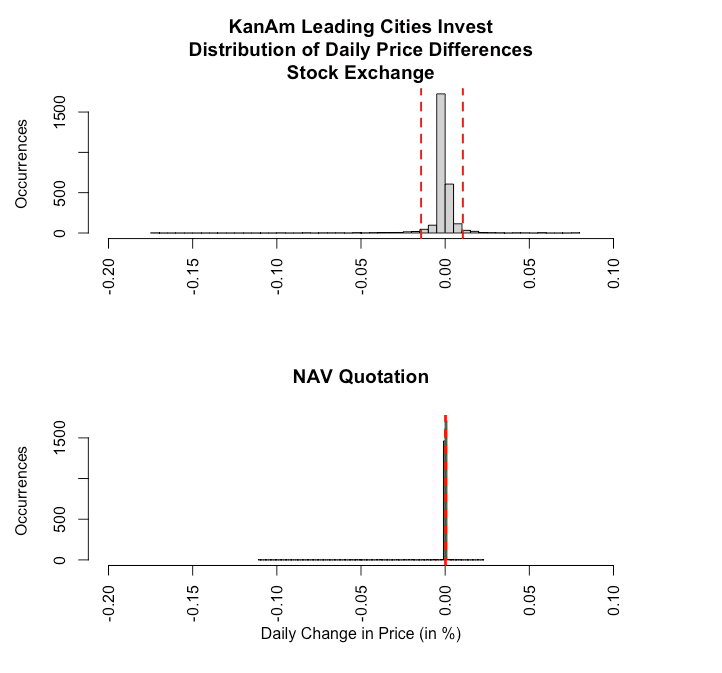
If you look at the Distribution of Daily Price Differences, the “body” of the distribution tells a story of absolute tranquility. For both the stock exchange pricing and the NAV quotation, the daily changes cluster tightly around 0%.
The Trigger: When Tail Behavior Takes Over
As recent research by the IREBS (International Real Estate Business School) highlights, open-ended real estate funds suffer from a high structural dependency on capital exits. When a trigger occurs, such as a significant commercial real estate devaluation, the pattern easily breaks.
Once institutional and retail investors feel the threat, capital outflows accelerate. Because real estate is fundamentally less liquid, the fund cannot sell properties fast enough to meet redemption requirements without destroying value. This triggers a vicious cycle:
- Devaluations force the NAV down.
- Falling NAV panics investors, accelerating capital outflows.
- The secondary market (stock exchange) panics ahead of the NAV, creating a massive discount.
This is exactly what happened to KanAm in November 2023 (see graph above).
Quantifying the Fat Tail: An alpha of 2.8
Moving from the peaceful “body” of the distribution to the “tail area”, it gets obvious, that Power Law - behavior takes over.
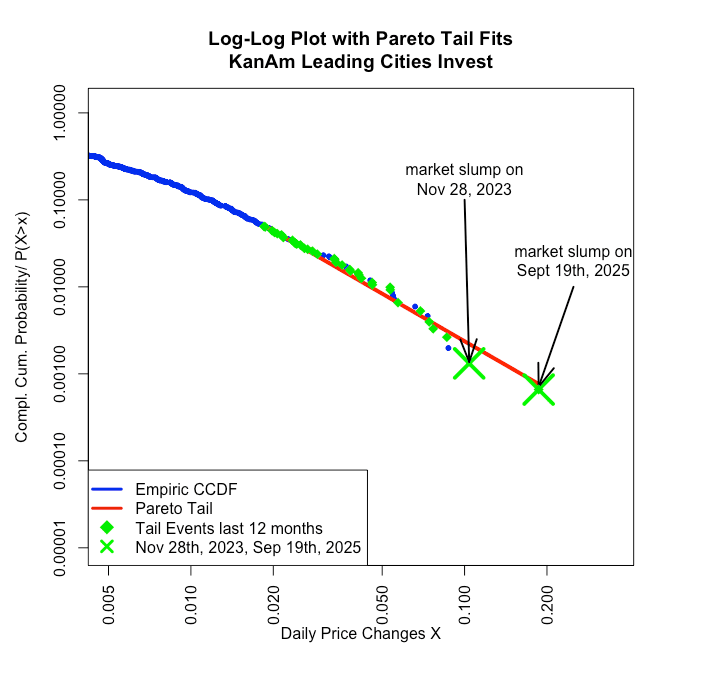
In the graph above, KanAm reveals a Pareto-tail with an alpha of 2.8. In the world of fat tails, an alpha this low indicates an incredibly fat tail. This means that extreme fluctuations are far more frequent and mathematically probable than the standard risk classification would ever suggest.
Considering the last 5 years in stock exchange pricing, KanAm’s Volatility Estimation Valuation (VEV) reached a staggering 23%. According to PRIIPs methodologies, this level of VEV does not land you in the low-risk or moderate-low risk classes. Rather, it firmly places the fund into Risk Class 5, sharing a risk profile with volatile equity funds and high-yield credit instruments.
The massive market slumps on November 28, 2023 and September 19, 2025, were the systemic manifestation of this fat tail. They were the Black Swans that signaled the end was near.
The Blueprint: Why UniImmo Wohnen ZBI is a Grey Swan
Taking KanAm as some kind of blueprint for open-ended real estate funds’ tail behavior, we must immediately turn our attention to other giants in the market, like UniImmo Wohnen ZBI.
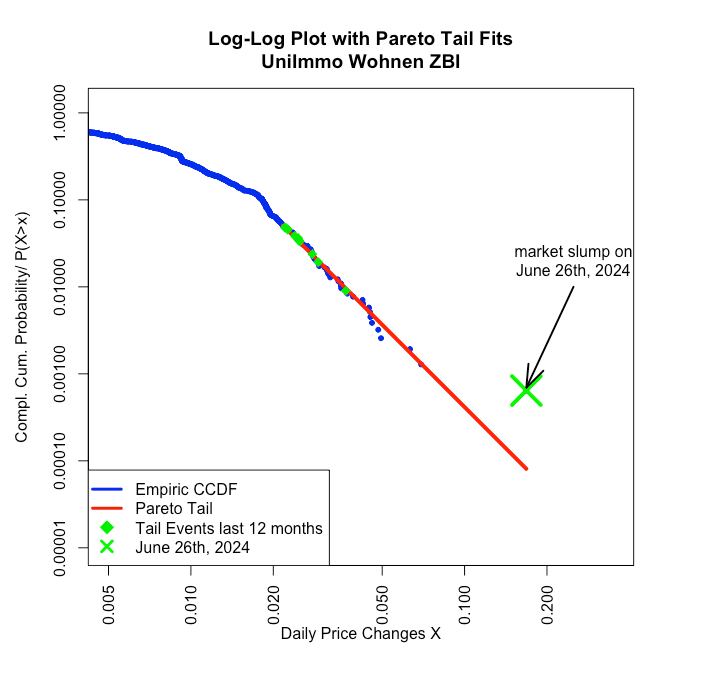
Again, a massive write-off in assets triggered a price slump in June 2024, indicating a Black Swan in the making. Though, the tail analysis suggests otherwise. The price slump in June 2024 was not a Black Swan but a Grey Swan. Something to be expected, as the price development enters its (fat) tail behavior.
As asset values continue to face pressure and the correlation of capital outflows increases across the industry, UniImmo is sitting on the exact same structural fault lines. The tail has already shown itself. In case the dependency of capital outflows tightens, a KanAm-style accelerating downward spiral has its potential and is not a distant mathematical impossibility.
Conclusion: Taming Open-Ended Funds with Sentiment Analytics
The winding down of KanAm Leading Cities Invest is a stark reminder that in finance, absence of evidence is not evidence of absence. Just because a fund hasn’t blown up in ten years doesn’t mean it is safe. It just means the tail hasn’t been triggered yet.
For regulators, distributors, and investors alike, relying on smooth historical NAV lines is a recipe for ruin. It is time to stop treating open-ended real estate funds as stable deposit alternatives, and start respecting them for what they truly are: wild, fat-tailed animals capable of creating heavy losses when the pattern finally breaks.
Ultimately, the systemic vulnerability of open-ended funds to rapid capital flight means that backward-looking quantitative metrics are no longer enough. To survive, fund managers are advised to shift their focus from historical market data towards real-time insights driven by market sentiment analytics. This gives them a chance to anticipate upcoming market developments, adjust their risk positions and prepare for the most probable reactions of their stakeholders in due time.