

CRE Market Sentiment Austria: The Hidden Signal in Uncertain Times
CRE market sentiment Austria is the first product roll out of D-DARKS GmbH aimed to help investors, lenders and commercial real estate professionals make better risk and investment decisions.
Market sentiment is not a soft concept. In commercial real estate, it is the earliest hard signal available: the collective reading of where conditions stand before any of that reading shows up in transaction data, vacancy statistics or yield movements. For institutional investors, lenders and advisors operating in the commercial real estate market, understanding how to measure that signal, and what to do with it, has become a more pressing question than it has been for some time.
Markets Are Driven by Numbers and Narrative
Commercial real estate runs on two parallel tracks simultaneously. The first is numerical: yields, vacancy rates, transaction volumes, financing spreads and it is well served by the industry's existing measurement infrastructure. Market reports, research publications and data providers have built sophisticated frameworks for capturing and distributing this information, and institutional decision-making is appropriately anchored in it.
The second track is narrative, and it has never been properly measured. Not because it is less important, in many respects it is the more consequential of the two, but because until recently there was no reliable way to read it systematically. Narrative travels through professional networks, through conversations at industry gatherings, through the editorial positions of specialist publications and the carefully worded statements of market participants. It is always the same circles, always the same voices, always filtered through the professional and commercial interests of whoever is willing to be quoted or to respond to a survey.
What makes this worth taking seriously is not that narrative is separate from the numbers. It is that narrative moves first. Market expectations shift in the language of the market before they appear in transaction data. The mood of a specific asset class or geography, the collective sense among practitioners that conditions are tightening, or that cautious optimism is beginning to replace anxiety, establishes the direction of capital movement before that movement is visible in any measurement that the industry currently produces at scale.
The Market Communicates Continuously and Simultaneously Across Many Channels
This is where the nature of the signal matters. Market sentiment is not expressed through a single channel. It emerges from the full spectrum of professional market communication: specialist trade publications, corporate press releases from listed companies, market reports from research houses, event commentary, expert analysis, earnings calls, insolvency filings, planning announcements and deal coverage. Each of these sources carries both narrative and, embedded within it, the market's own framing of quantitative reality.
When a listed real estate company describes its refinancing position in a press release, it is not just providing a number. It is expressing a level of confidence, concern or strategic orientation that a number alone cannot capture. When a research house publishes a market report on the Austrian office market, the language in which it frames vacancy trends tells as much as the vacancy figure itself. When trade publications begin covering a particular topic such as insolvency risk, ESG pressure or interest rate sensitivity, with increasing frequency and intensity, that shift in editorial focus is itself a signal.
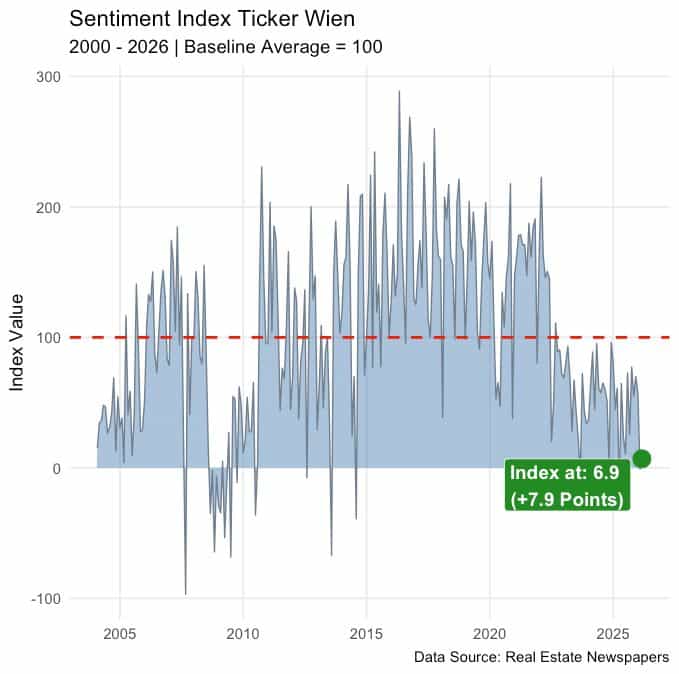
The D-DARKS CRE Market Sentiment Index reads this full corpus of market communication systematically, extracting and quantifying the signal embedded across all of these source types simultaneously. The market was always producing this language. What has changed is the ability to read it at scale, continuously and without the structural limitations of traditional measurement approaches.
The Gap Between What the Market Is Saying and What the Data Will Eventually Show
Every experienced commercial real estate professional in commercial real estate has encountered the same phenomenon. You arrive at a major industry gathering such as Expo Real, MIPIM, a significant regional conference and within the first day of conversations you have a clear sense of where the market stands. Whether the dominant tone is cautious optimism, silent anxiety, or something more difficult to characterise, the aggregate of professional conversations produces a reading that experienced practitioners trust, because they have seen it precede market movements often enough to take it seriously.
The problem is not that this reading is unreliable. The problem is that it is not scalable, not quantifiable, and not comparable across time periods or geographies. It reflects whoever you spoke to, filtered through your own network and your own analytical framework, and it disappears the moment the conference ends.
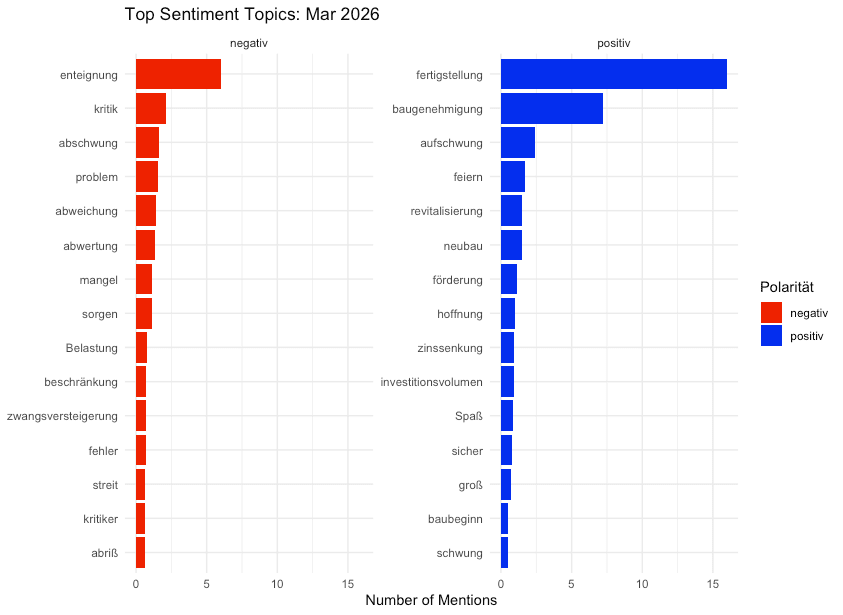
Data-driven CRE market sentiment analysis does not replace that practitioner instinct. It extends it by reading the equivalent of thousands of professional conversations across every major source of specialist market communication in Austria, across every asset class, and producing a single quantified reading that can be tracked over time, broken down by geography and asset class, and interrogated for the specific topics and concerns that are driving the mood at any given moment.
Two Layers of Intelligence
Measuring the signal, however, is only the first part of what is useful. Market sentiment does not exist independently of market conditions. The sentiment the D-DARKS index captures is shaped, in part, by the empirical realities of the Austrian CRE market: by financing conditions, by transaction activity, by the performance of specific asset classes, all of which enter the market communication we measure and are therefore already embedded in the signal.
What that signal means in the context of current market conditions, and what the implications are for specific investment decisions, asset classes or geographies, requires a second layer: expert interpretation by practitioners who have spent decades working with these markets. The index tells you where collective market conviction currently stands. The report contextualises it, drawing on the kind of market experience that gives a quantified signal its practical meaning.
This combination: AI-powered measurement of the full market narrative, interpreted by commercial real estate practitioners is the foundation of the D-DARKS approach to CRE market intelligence.
What This Series Covers
This is the first in a series of posts examining how data-driven sentiment analysis works, what it measures, and why the methodology represents a meaningful advance over traditional approaches. The following posts will examine the structural limitations of telephone-based survey indices, the four dimensions of sentiment that a single positive/negative score cannot capture, the importance of granularity by asset class and geography, and the role of topic analysis and sentiment volatility as forward-looking signals.
D-DARKS measures the narrative of the commercial real estate market continuously, drawing from the full spectrum of professional market communication and interpreted by practitioners with decades of market experience.