
Close

Across the open-ended real estate fund segment, one word returns in almost every conversation: the trust. It appears wherever the current equity strain is discussed, and its restoration is often described as the way out of the capital drain.
The instinct behind that word is understandable and it can be something a fund earns through its own conduct given the often mentioned disadvantage of its business model, which rests on a known structural tension: long-term, illiquid assets are funded by capital that can be withdrawn at short notice. Given that tension, and given recent events across the segment, the clearest signal of trustworthiness would have to come from the funds themselves. One very obvious and visible way would be shown in the picture on how faithfully their numbers track the market around them.
On that measure, the current situation invites some questions. Across the segment, published valuations reflect present conditions only partially. In certain cases the gap is wider than partial. The reported value does not simply lag the market; over recent years it has continued to rise while the market has moved the other way.
This piece tests that claim against a single fund of a common profile: first against the market around it, then against its own structure.
1. The divergence
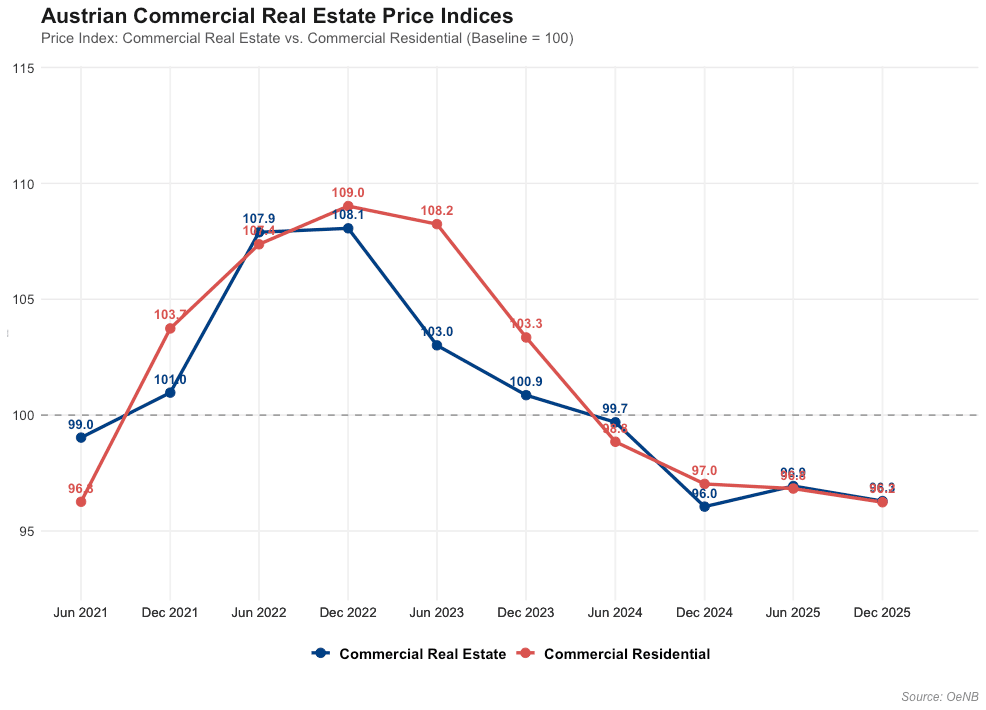
Reading a fund against the market first requires a measure of the market that no single fund controls. The OeNB Commercial Real Estate Price Index serves that purpose. It covers the period from June 2021 to December 2025, and it shows a clear decline from the middle of 2022, coinciding with the start of the ECB rate-tightening cycle. Both the commercial real estate and the commercial residential series fall from a peak near 108 to 109 at the end of 2022 to roughly 96 by the end of 2025. Depending on the asset class, the reduction from the mid-2022 peak runs between roughly 9 and 14 percent. Germany shows a broadly comparable pattern over the same period.
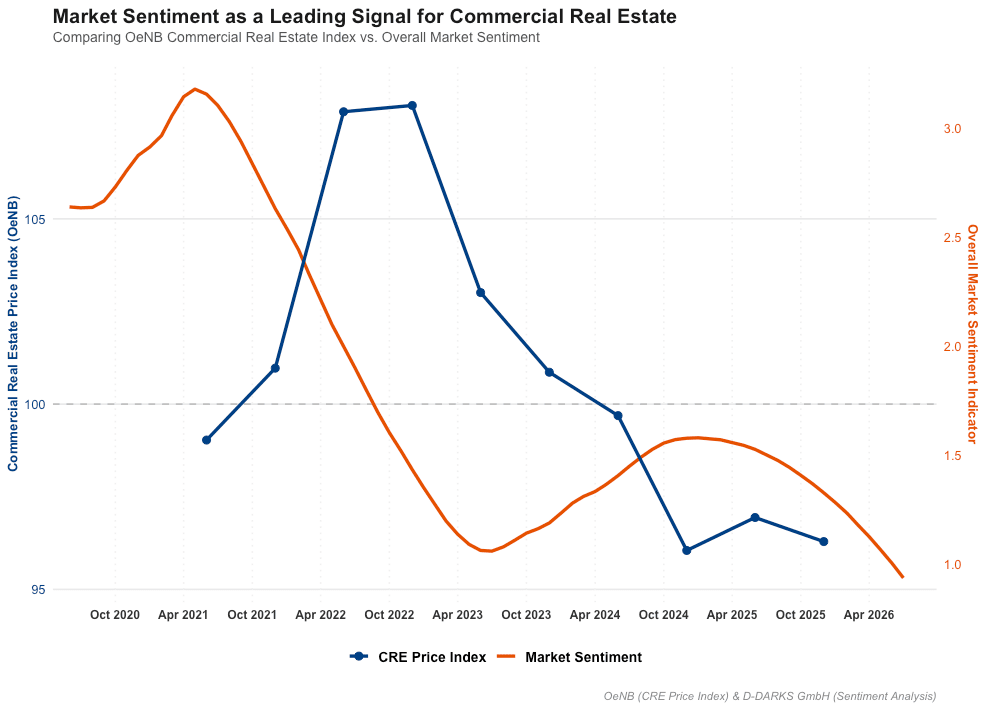
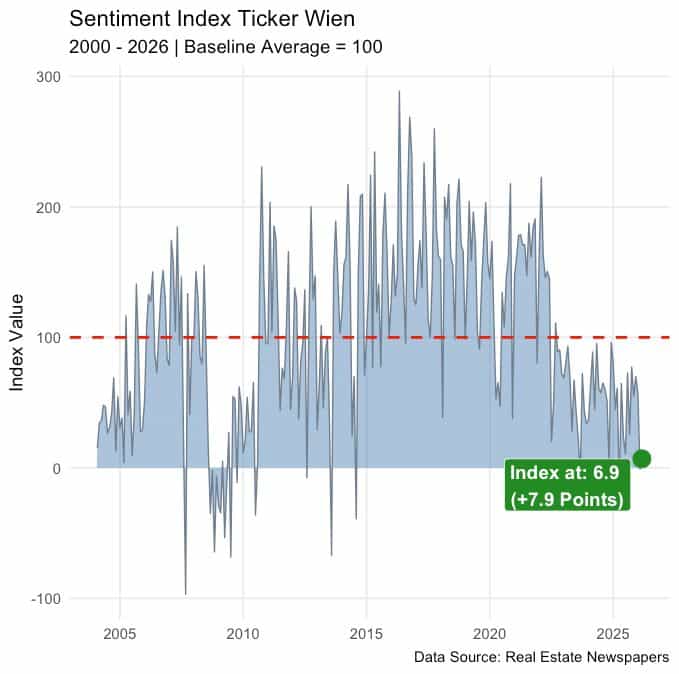
At this point, the official index only covers the period till December 2025. To fill the gap to the present, mid-2026, and to see where prices are heading next, we turn to the D-DARKS Market Sentiment Index, which gives no sign of improvement through the remainder of 2026. Measured consistently from institutional and market communication, sentiment has anticipated the turns in the price index before, at the peak and again at the low. Right now it is falling again, which suggests prices will weaken further rather than recover in 2026.
Set against that backdrop, consider a fund of a common profile. It carries a daily NAV quotation and holds commercial real estate in Germany and Austria. Close to half of the portfolio consists of office assets, with another 15 percent in commercial residential assets. In composition, the fund comes close to what the OeNB index represents. Its NAV, driven mainly by the appraisal-based valuation of the underlying assets, nevertheless shows uninterrupted appreciation across the same period, and across the two decades before it.
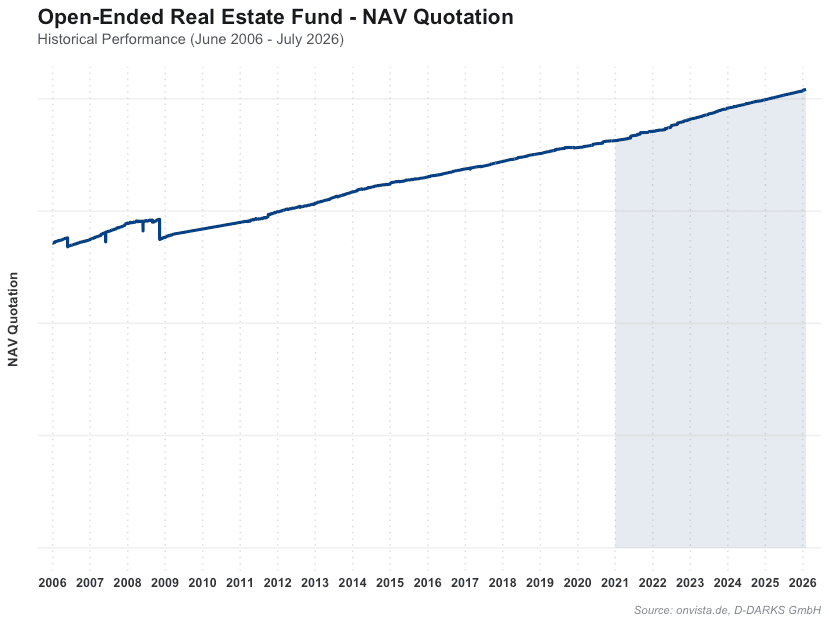
So here, two independent readings of the market point down, and the fund points up. The question worth asking is a plain one. What mechanism allows an appraisal-based NAV to remain insulated from a market its own portfolio closely tracks?
2. The portfolio and the timing
Part of the answer rests in the timing of acquisition. A fund of this profile typically follows a pro-cyclical strategy. When setting the timing of the portfolio purchase against prime office yields in Vienna and Frankfurt, the concentration becomes clear. The bulk of the portfolio was acquired roughly between 2016 and 2021, when prime yields stood well below current levels. Around 80 percent was bought into that low-yield window. Prime yields have since risen back toward, and past, their levels of a decade earlier.
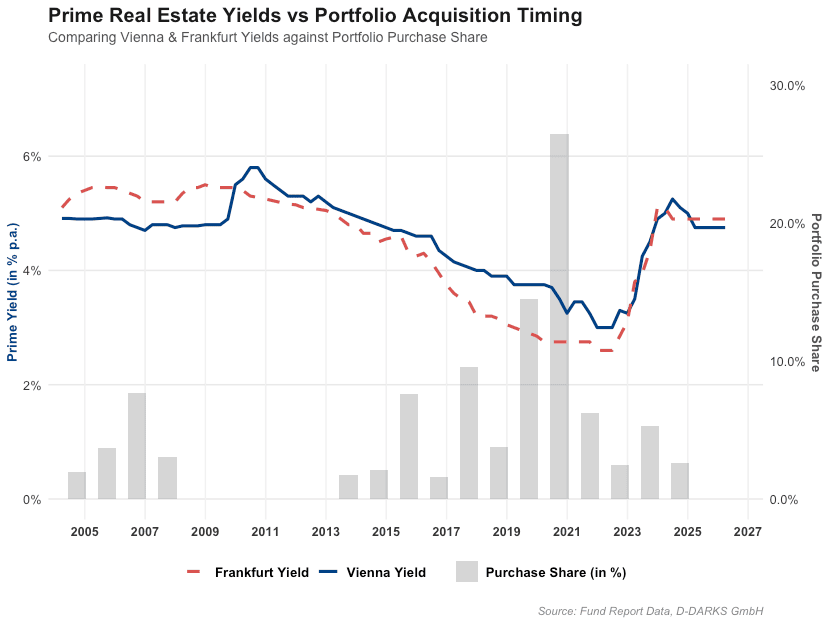
Cyclical behaviour tends to have consequences in both directions. Inflation lifts rents and, in turn, supports valuations, yet that support does not offset the heavy yield shift of the past two to three years. The fund’s reporting bears this out in a particular way. Devaluations and revaluations across the portfolio net out to a negligible overall effect, while the NAV continues its slow and steady rise. The result is a number that stays calm while the market underneath it moves.
3. The liquidity mechanism
Operationally, a portfolio of this kind can look sound. Occupancy near 95 percent meets the benchmark of peer funds. Operating cash flow remains positive, though in the first half of 2026 gets noticeably reduced by maintenance costs. The strain, therefore, does not originate in operations, but on the liability side of the fund.
The Cash Flows below are shown as representative of that profile. They make the underlying pattern legible:
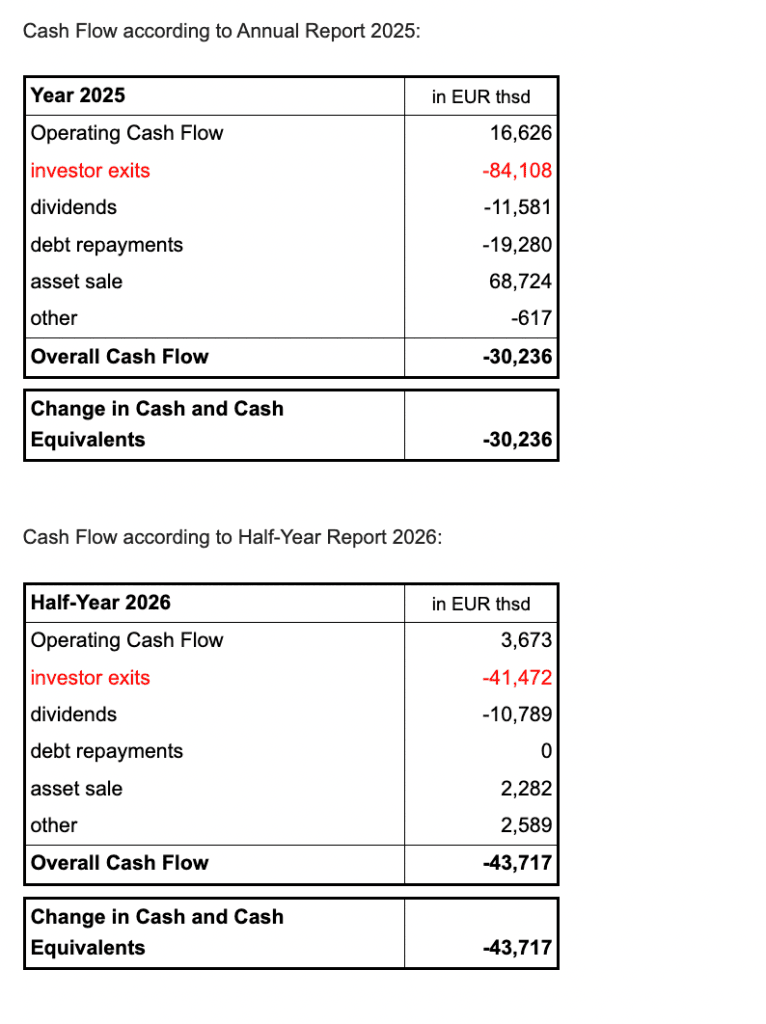
Two figures carry this section. Over eighteen months, net investor exits reach roughly EUR 125 million. Together with dividends and debt service, the fund draws down more than 40 percent of its cash and cash-equivalent position during this short period. The six-month drain in the first half of 2026 already exceeds the full-year drain of 2025.
The asset side does not keep pace with that demand. Sale proceeds in 2025 already lagged behind cash requirements. In the first half of 2026 no major sale was completed. Two disposals were announced without published prices, and the associated debt repayments still fall due within the year. The 2025 sales realised a slight loss, modest in isolation, though less so read as a leading indicator under continued pressure.
This is the structural point, and it belongs to no single manager. Long-term, illiquid assets are funded by equity that can be redeemed at short notice. While the rating framework stays benign, that mismatch remains invisible. When it turns, redemptions convert an appraisal-stable NAV into a liquidity problem, and disposals into forced disposals.
4. What the structure produces
A NAV that rises through a falling market does not remove the risk, but it relocates it, from the price itself to the moment the price finally moves. That is the illusion of safety expressed in a single line: the number looks calmest precisely where the exposure is building.
For a fund of this profile, the consequences fall on the remaining investors rather than the departing ones. Leaving investors are paid out at a NAV that has not yet reflected the market. Should redemption pressure persist and disposals continue to lag, the fund may need to reach out for liquidity measures. Remaining investors would then face the risk of abrupt NAV corrections, delayed access to their capital, or both together. Upcoming changes to the investment fund law framework, effective from the beginning of 2027 (read more about it here) are widely expected to add to redemption pressure in the short run rather than relieve it.
Here the structure meets its own limit. Valuation of this kind is event-based and, by design, backward-looking. It records the strain only after the fact. The market's own signals move well earlier, as Section 1 showed with the sentiment reading. They appear ahead of the appraisal that eventually confirms them. That interval, between what the market already indicates and what the NAV has yet to record, is the whole difference between managing an exposure and being overtaken by one.
We are pleased to announce a media partnership with immobilien investment, the real estate and investment magazine of DMV Della Lucia Medien & Verlags GmbH.
At the core of what we do is Market Intelligence: a method that reads communication across the real estate industry to capture not only where the market currently stands, but early indications of where it is heading. It draws on a combination of sources:
Because the quality of these readings depends directly on the quality of what feeds them, we take particular care in selecting which media sources enter our data pool. Only outlets with an objective reporting standard and a strict, independent editorial approach qualify; coverage shaped by advertising interest or promotional intent does not. Immobilien investment fits that criteria very well.
The partnership has two sides. immobilien investment's market coverage will, going forward, flow in part into our analytics, alongside the other data sources our Market Intelligence engine draws on, above all institutional and market communication. From these combined inputs, we derive quantified measures of market condition: Stimmungsindex, Stresslevel, and Marktanspannung.
In return, immobilien investment becomes the exclusive outlet in the Austrian real estate space where we publish our Market Intelligence findings. Beginning with the coming issue, readers will find regular analyses of the commercial market, supplemented over time by tail risk assessments of individual market segments and by pieces on the structural questions of the current cycle.
Our motivation is straightforward. Much of the analytical toolkit in real estate looks backward: valuations, indices, and risk indicators that describe where the market has been. The methods we work with, such as sentiment measurement and tail risk analytics are designed to show where the market stands now and to give an earlier indication of where it is heading. We want to make visible to the industry that such data and methods exist, that they are applicable to real estate, and that they can meaningfully widen the picture on which decisions are based.
Immobilien investment is the right place for this. Its readership is a professional one, including investors, financiers, developers, and asset managers who work with market data daily and know its limits from experience. We expect that an additional, forward-looking perspective will find an open audience there.
The first analysis appears in the next issue of immobilien investment.
Austrian commercial real estate market sentiment at a glance: The D-DARKS CRE Sentiment Index for Austrian commercial real estate has dropped to 14.6 points in April 2026, a plunge of 43.1 points versus the previous month. Despite seemingly positive transaction data, the qualitative market sentiment tells a completely different story: not a recovery, but structural resignation.
| Indicator | Value | Assessment |
|---|---|---|
| Sentiment Index | –14.6 points | Negative |
| Month-on-month change | –43.1 points | Sharp decline |
| Market trend | Pessimistic corridor | No recovery |
| Primary catalyst | Geopolitics (Middle East) | External shock |
At the start of 2026, voices within the Austrian commercial real estate industry increasingly spoke of a recovery or even of a new property cycle. This view was supported above all by a transaction volume of approximately EUR 540 million in the first quarter of 2026, roughly 37% higher than the same period a year earlier.
But this optimism is deceptive. Commercial real estate transactions typically require six to nine months from initial expression of interest to closing. The deals we see in today's statistics therefore reflect market expectations from mid-2025, not the current sentiment landscape.
This also explains why gross yields across individual asset classes (office, retail, hotel, logistics) currently still appear stable at high levels, despite the deteriorating overall picture.
The D-DARKS CRE Sentiment Index is based on systematic NLP analysis of 25 years of German-language commercial real estate news. In April 2026, the index sends a clear warning signal:
For the first time in a long while, market sentiment has turned negative. The index underscores how persistently depressed expectations in the Austrian commercial real estate market have become.
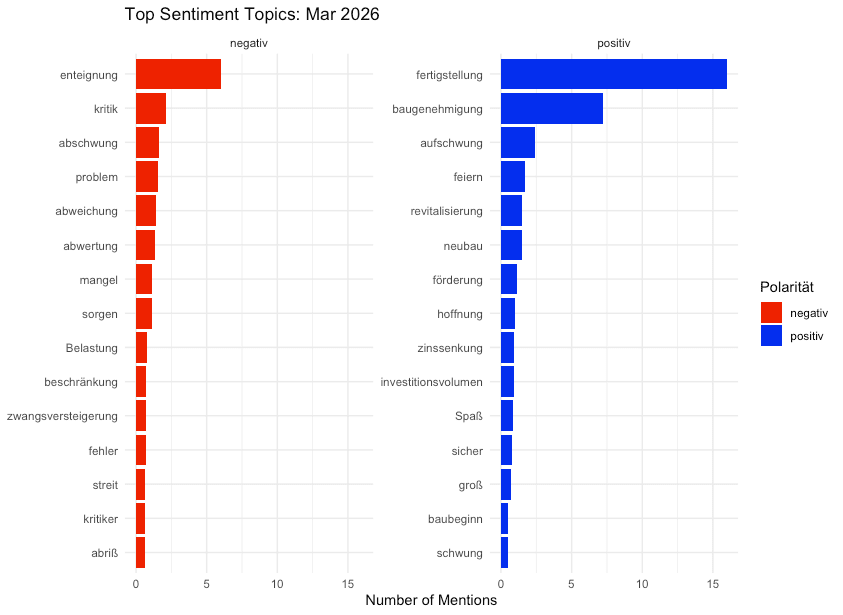
Quantitative topic analysis reveals a sudden dominance of negative terminology, while positive voices have effectively imploded. The five most frequently cited negative terms in April 2026:
Particularly noteworthy: terms like "panic" and "recession" are no longer mentioned only by isolated voices, but are now used across a broad spectrum of market participants. The Middle East conflict acts as a catalyst, amplifying pre-existing concerns.
Unlike during the 2007/2008 financial crisis, the Austrian commercial real estate market in spring 2026 shows no signs of acute shock. The D-DARKS stress level, a combined indicator of sentiment and volatility, remains relatively low despite the negative mood.
What does this mean? Market participants have collectively adjusted to the bad news. There are barely any meaningful counter-voices or fundamental uncertainty about the future direction of the market. The industry is no longer drifting toward pessimism temporarily, sentiment has now structurally locked itself into a pessimistic corridor.
Should this trend solidify, the following developments are likely:
Expectations drive price formation, particularly in commercial real estate. Those who recognize early in which direction the market narrative is shifting gain a decisive lead-time advantage over backward-looking transaction data.
The market is not in recovery mode but has structurally locked into a pessimistic corridor. The D-DARKS CRE Sentiment Index stands at –14.6 points in April 2026.
Q1 2026 transactions reflect market expectations from 6–9 months earlier. Current sentiment will therefore only show up in transaction volumes with a significant time lag.
Not at the moment. Unlike in the 2007/2008 financial crisis, stress levels are low. There is no panic, but a consolidated resignation among market participants.
Gross yields for office, retail, hotel and logistics currently still hold at high levels, but an adjustment over the coming quarters is likely.
The Austrian commercial real estate market is sending a clear warning in April 2026. Those who rely solely on backward-looking transaction data risk missing the structural shift in market expectations. Qualitative market intelligence becomes the decisive early-warning tool for institutional investors.
Disclaimer: This article is based on NLP-driven sentiment analysis of German-language commercial real estate news (monthly data 2000–2026) and does not constitute investment advice.
CRE market sentiment Austria is the first product roll out of D-DARKS GmbH aimed to help investors, lenders and commercial real estate professionals make better risk and investment decisions.
Market sentiment is not a soft concept. In commercial real estate, it is the earliest hard signal available: the collective reading of where conditions stand before any of that reading shows up in transaction data, vacancy statistics or yield movements. For institutional investors, lenders and advisors operating in the commercial real estate market, understanding how to measure that signal, and what to do with it, has become a more pressing question than it has been for some time.
Markets Are Driven by Numbers and Narrative
Commercial real estate runs on two parallel tracks simultaneously. The first is numerical: yields, vacancy rates, transaction volumes, financing spreads and it is well served by the industry's existing measurement infrastructure. Market reports, research publications and data providers have built sophisticated frameworks for capturing and distributing this information, and institutional decision-making is appropriately anchored in it.
The second track is narrative, and it has never been properly measured. Not because it is less important, in many respects it is the more consequential of the two, but because until recently there was no reliable way to read it systematically. Narrative travels through professional networks, through conversations at industry gatherings, through the editorial positions of specialist publications and the carefully worded statements of market participants. It is always the same circles, always the same voices, always filtered through the professional and commercial interests of whoever is willing to be quoted or to respond to a survey.
What makes this worth taking seriously is not that narrative is separate from the numbers. It is that narrative moves first. Market expectations shift in the language of the market before they appear in transaction data. The mood of a specific asset class or geography, the collective sense among practitioners that conditions are tightening, or that cautious optimism is beginning to replace anxiety, establishes the direction of capital movement before that movement is visible in any measurement that the industry currently produces at scale.
The Market Communicates Continuously and Simultaneously Across Many Channels
This is where the nature of the signal matters. Market sentiment is not expressed through a single channel. It emerges from the full spectrum of professional market communication: specialist trade publications, corporate press releases from listed companies, market reports from research houses, event commentary, expert analysis, earnings calls, insolvency filings, planning announcements and deal coverage. Each of these sources carries both narrative and, embedded within it, the market's own framing of quantitative reality.
When a listed real estate company describes its refinancing position in a press release, it is not just providing a number. It is expressing a level of confidence, concern or strategic orientation that a number alone cannot capture. When a research house publishes a market report on the Austrian office market, the language in which it frames vacancy trends tells as much as the vacancy figure itself. When trade publications begin covering a particular topic such as insolvency risk, ESG pressure or interest rate sensitivity, with increasing frequency and intensity, that shift in editorial focus is itself a signal.
The D-DARKS CRE Market Sentiment Index reads this full corpus of market communication systematically, extracting and quantifying the signal embedded across all of these source types simultaneously. The market was always producing this language. What has changed is the ability to read it at scale, continuously and without the structural limitations of traditional measurement approaches.
The Gap Between What the Market Is Saying and What the Data Will Eventually Show
Every experienced commercial real estate professional in commercial real estate has encountered the same phenomenon. You arrive at a major industry gathering such as Expo Real, MIPIM, a significant regional conference and within the first day of conversations you have a clear sense of where the market stands. Whether the dominant tone is cautious optimism, silent anxiety, or something more difficult to characterise, the aggregate of professional conversations produces a reading that experienced practitioners trust, because they have seen it precede market movements often enough to take it seriously.
The problem is not that this reading is unreliable. The problem is that it is not scalable, not quantifiable, and not comparable across time periods or geographies. It reflects whoever you spoke to, filtered through your own network and your own analytical framework, and it disappears the moment the conference ends.
Data-driven CRE market sentiment analysis does not replace that practitioner instinct. It extends it by reading the equivalent of thousands of professional conversations across every major source of specialist market communication in Austria, across every asset class, and producing a single quantified reading that can be tracked over time, broken down by geography and asset class, and interrogated for the specific topics and concerns that are driving the mood at any given moment.
Two Layers of Intelligence
Measuring the signal, however, is only the first part of what is useful. Market sentiment does not exist independently of market conditions. The sentiment the D-DARKS index captures is shaped, in part, by the empirical realities of the Austrian CRE market: by financing conditions, by transaction activity, by the performance of specific asset classes, all of which enter the market communication we measure and are therefore already embedded in the signal.
What that signal means in the context of current market conditions, and what the implications are for specific investment decisions, asset classes or geographies, requires a second layer: expert interpretation by practitioners who have spent decades working with these markets. The index tells you where collective market conviction currently stands. The report contextualises it, drawing on the kind of market experience that gives a quantified signal its practical meaning.
This combination: AI-powered measurement of the full market narrative, interpreted by commercial real estate practitioners is the foundation of the D-DARKS approach to CRE market intelligence.
What This Series Covers
This is the first in a series of posts examining how data-driven sentiment analysis works, what it measures, and why the methodology represents a meaningful advance over traditional approaches. The following posts will examine the structural limitations of telephone-based survey indices, the four dimensions of sentiment that a single positive/negative score cannot capture, the importance of granularity by asset class and geography, and the role of topic analysis and sentiment volatility as forward-looking signals.
D-DARKS measures the narrative of the commercial real estate market continuously, drawing from the full spectrum of professional market communication and interpreted by practitioners with decades of market experience.