
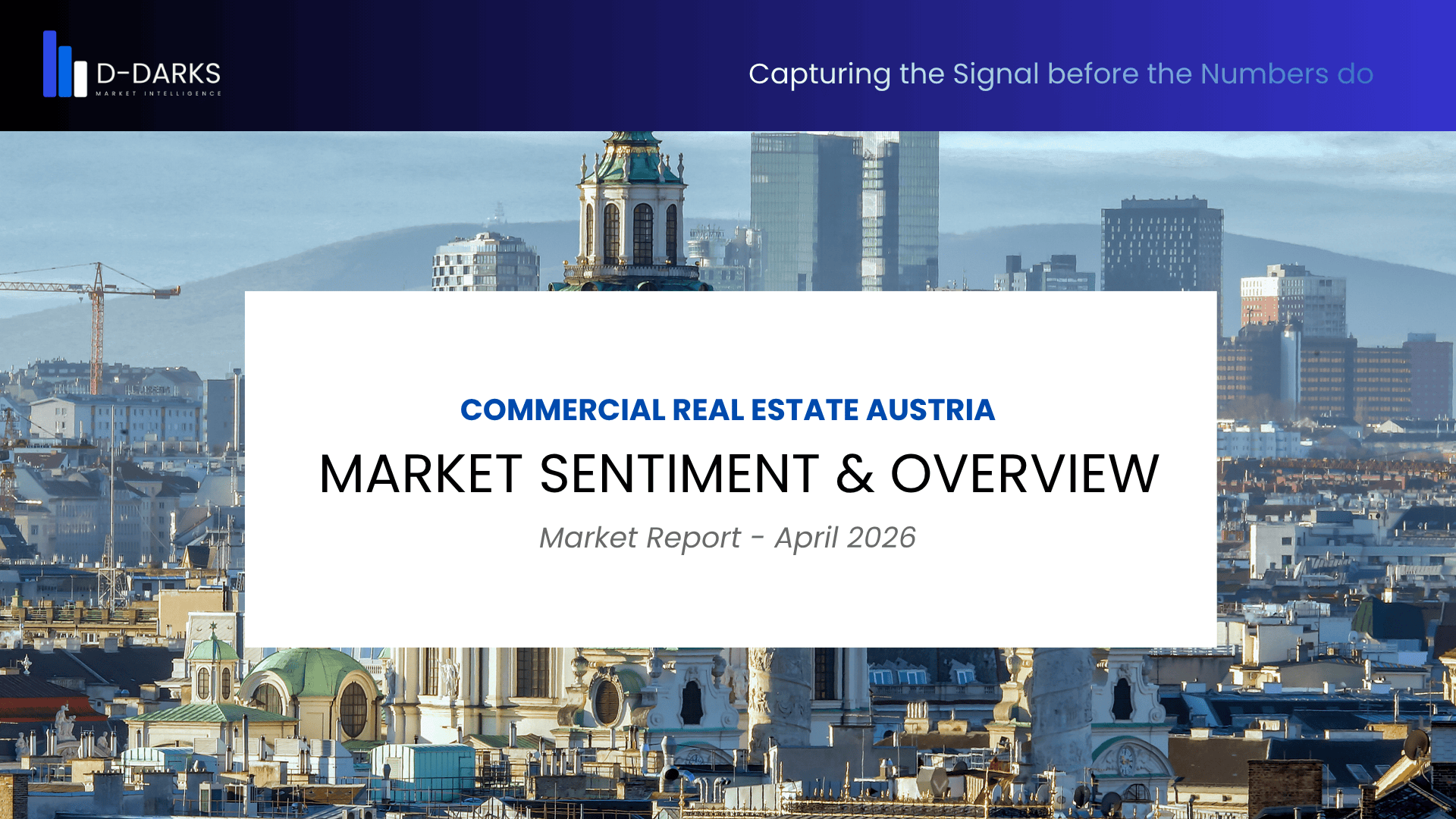
Austrian Commercial Real Estate: Why Market Sentiment is Crashing in April 2026 and What It Means for Investors
Austrian commercial real estate market sentiment at a glance: The D-DARKS CRE Sentiment Index for Austrian commercial real estate has dropped to 14.6 points in April 2026, a plunge of 43.1 points versus the previous month. Despite seemingly positive transaction data, the qualitative market sentiment tells a completely different story: not a recovery, but structural resignation.
Key metrics for the Austrian commercial real estate market in April 2026
| Indicator | Value | Assessment |
|---|---|---|
| Sentiment Index | –14.6 points | Negative |
| Month-on-month change | –43.1 points | Sharp decline |
| Market trend | Pessimistic corridor | No recovery |
| Primary catalyst | Geopolitics (Middle East) | External shock |
The false optimism: Why transaction data is misleading
At the start of 2026, voices within the Austrian commercial real estate industry increasingly spoke of a recovery or even of a new property cycle. This view was supported above all by a transaction volume of approximately EUR 540 million in the first quarter of 2026, roughly 37% higher than the same period a year earlier.
But this optimism is deceptive. Commercial real estate transactions typically require six to nine months from initial expression of interest to closing. The deals we see in today's statistics therefore reflect market expectations from mid-2025, not the current sentiment landscape.
This also explains why gross yields across individual asset classes (office, retail, hotel, logistics) currently still appear stable at high levels, despite the deteriorating overall picture.
Austria CRE Sentiment Index: Sharp decline in April
The D-DARKS CRE Sentiment Index is based on systematic NLP analysis of 25 years of German-language commercial real estate news. In April 2026, the index sends a clear warning signal:
- April 2026 value: –14.6 points
- Change: –43.1 points month-on-month
- Trend since the Covid crisis: Almost continuously below the long-term average
- Since September/October 2025: Renewed deterioration in market sentiment
For the first time in a long while, market sentiment has turned negative. The index underscores how persistently depressed expectations in the Austrian commercial real estate market have become.
Implosion of positive rhetoric: What the market is talking about now
Quantitative topic analysis reveals a sudden dominance of negative terminology, while positive voices have effectively imploded. The five most frequently cited negative terms in April 2026:
- Risk
- Dislocation
- Foreclosure
- Panic
- Recession
Particularly noteworthy: terms like "panic" and "recession" are no longer mentioned only by isolated voices, but are now used across a broad spectrum of market participants. The Middle East conflict acts as a catalyst, amplifying pre-existing concerns.
Not panic, but consolidated resignation
Unlike during the 2007/2008 financial crisis, the Austrian commercial real estate market in spring 2026 shows no signs of acute shock. The D-DARKS stress level, a combined indicator of sentiment and volatility, remains relatively low despite the negative mood.
What does this mean? Market participants have collectively adjusted to the bad news. There are barely any meaningful counter-voices or fundamental uncertainty about the future direction of the market. The industry is no longer drifting toward pessimism temporarily, sentiment has now structurally locked itself into a pessimistic corridor.
What this means for institutional investors
Should this trend solidify, the following developments are likely:
- Yield adjustment over the next 6–9 months
- Liquidity drying up in the transaction market
- Extended transaction timelines due to heightened due-diligence requirements
- Widening bid-ask spreads between buyers and sellers
Expectations drive price formation, particularly in commercial real estate. Those who recognize early in which direction the market narrative is shifting gain a decisive lead-time advantage over backward-looking transaction data.
Frequently asked questions (FAQ)
How is the Austrian commercial real estate market developing in 2026?
The market is not in recovery mode but has structurally locked into a pessimistic corridor. The D-DARKS CRE Sentiment Index stands at –14.6 points in April 2026.
Why are transaction volumes rising despite poor sentiment?
Q1 2026 transactions reflect market expectations from 6–9 months earlier. Current sentiment will therefore only show up in transaction volumes with a significant time lag.
Is another property crisis like 2008 looming?
Not at the moment. Unlike in the 2007/2008 financial crisis, stress levels are low. There is no panic, but a consolidated resignation among market participants.
Which asset classes are most affected?
Gross yields for office, retail, hotel and logistics currently still hold at high levels, but an adjustment over the coming quarters is likely.
Conclusion: Capture the signal before the numbers do
The Austrian commercial real estate market is sending a clear warning in April 2026. Those who rely solely on backward-looking transaction data risk missing the structural shift in market expectations. Qualitative market intelligence becomes the decisive early-warning tool for institutional investors.
Disclaimer: This article is based on NLP-driven sentiment analysis of German-language commercial real estate news (monthly data 2000–2026) and does not constitute investment advice.